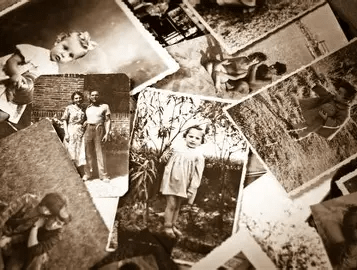
In My Day Building on the Past to Shape the Future
It’s become something of a national pastime to start a sentence with, “Well, in my day…” — usually followed by a story that sounds like a cross between a Monty Python sketch and a survival manual.
I hear it all the time, and I’ll admit, I’ve said it myself once or twice. (Alright, maybe more than twice.)
I grew up in a house where ice formed on the inside of the windows.
Not the trendy Scandinavian kind, either — I mean actual, crunchable frost.
We’d wake up in the morning, see our breath in the bedroom, and think it was perfectly normal.
If you were lucky, you got to scrape your initials into the ice before sprinting downstairs to the coal fire that only heated one room — and only if you’d managed to coax it to life with half a newspaper and a lot of prayer.
Bath night was Sunday.
Not “bath nights” plural. One.
Shared, if you were unlucky, with your siblings.
If you were last in the queue, you didn’t so much bathe as just rearrange the dirt.
And of course, there was always that claim that we walked 20 miles through the snow to school, uphill both ways.
It’s funny now, but that image — immortalised by the Monty Python “Four Yorkshiremen” sketch — perfectly captures how we exaggerate the hardships of our youth and turn them into moral lessons for today’s children.
(“You had an iPad? Luxury! We were lucky to have a pencil!”)
But here’s the truth: it wasn’t idyllic.
It was cold.
It was tough.
It was, and quite frankly, a bit grim.
And yet, through the fog of memory, it’s easy to forget that and convince ourselves that life was somehow better back then.
The Nostalgia Trap: We all have those moments when we think,
“Everything’s gone downhill since…” — fill in your own year of choice.
For me, it’s usually somewhere between the end of proper buses and the rise of reality television.
And yet, there are parts of the past worth missing.
Back then, public transport worked because it had to.
Few people owned cars, so buses were frequent, punctual, and went where people actually lived.
Today, we have more cars than people, yet somehow, fewer ways to get around without one.
And then there’s the mythical “bobby on the bike.”
You know the one — the kindly policeman who kept the peace with a stern look and a gentle clip round the ear.
He’s as much a part of our collective imagination as unicorns and affordable housing.
Truth be told, most of us never met him.
He probably existed only on black-and-white television, where everyone wore a hat and nobody swore.
The Truth About “The Good Old Days”: When people sigh about “kids today,” I sometimes wonder what we expect them to do differently.
The world we see now is the one we built.
The parents and grandparents of today’s teenagers grew up in the 60s, 70s, and 80s — the era of social change, fast food, cheap flights, and instant gratification.
It’s a bit rich to complain that today’s youth are glued to their phones when we were the ones who invented the technology and marketed it to them.
We’ve shaped this world, so we can’t scold the next generation for trying to survive in it.
The real challenge is to make sure we hand over something better than we received — not just warmer houses, but warmer communities.
Sixty-Two People and a Cup of Perspective: Here’s a thought that stops me in my tracks: it took 62 people — 31 men and 31 women — across five generations to make you possible.
Think about that.
Sixty-two lives, each with their own struggles, triumphs, and probably at least one dodgy haircut, all leading up to this moment.
That’s an unbroken chain stretching back through history — and we’re now one of the links.
It’s humbling, really.
We don’t owe those ancestors anything, but we do owe something to the generations who’ll come after us.
They’ll inherit the world we build — our towns, our climate, our choices.
One day, they’ll look back at photographs of us and say, “They didn’t have flying cars, but they did alright.”
Building the Future Without Breaking the Past:
That’s where nostalgia can be both a comfort and a trap.
In local government, I see it all the time.
Every town has its version of “Why can’t it stay the way it was?” — but if we’d always listened to that, we’d still be lighting coal fires and sharing Sunday baths.
When we regenerate places like Queen Street, Market Hall or Bradley Lane, it’s not about erasing the past.
It’s about honouring it by building on it.
Every new brick, every redesigned space, is a continuation of a story — one written by those who came before, for those yet to come.
I like to think our job isn’t to preserve nostalgia, but to preserve purpose.
To make sure the future still feels like home, even as it changes.
So yes, I’ll still tell stories that begin with “In my day…” because they make me smile — and occasionally make others laugh.
But I’ll also finish the sentence with a reminder:
“In my day, we made do. But in their day, let’s make better.”
Because the past was never perfect. It was just ours. And now, it’s our turn to build a future worth someone else’s nostalgia.
Author’s Note
David Palethorpe is the Deputy Leader of Teignbridge District Council and Executive Member for Economic Development, Assets, and Communications. He writes about community, regeneration, and public purpose — often with a dash of humour. This reflection was inspired by the conversations surrounding local renewal projects in Newton Abbot, Devon such as Queen Street, Market Hall and Bradley Lane, and by the belief that progress isn’t about losing what we love, but passing on something better.

Leave a comment